
Wednesday, April 2, 2014

Tuesday, April 1, 2014
Follow these tips to price your home correctly
 Along with choosing a real estate agent that you’re comfortable with and marketing the home effectively, determining the correct asking price are three essential aspects of selling your home quickly and for the highest amount possible. The first are personal decisions; the last requires some research, finesse and some educated guessing.
Here are some tips to help you price your home right.
Look at the neighborhood
Consider comparable homes nearby that were for sale, recently sold or are currently for sale. This is perhaps the most important factor in pricing your home.
Local market conditions
Home sales is no different than any other industry. Supply and demand is a determinant of price. Your REALTOR® will have information about the supply of available homes compared to the demand of buyers.
Check out the competition
Visit open houses in the area to see how your home stacks up.
Price to appraise
The buyer’s appraisal price considers the prices of recently sold homes. Your sales price will be subject to an appraisal, unless your buyer agrees to pay cash or waives an appraisal contingency.
Don't pay for an appraisal
Though the buyer's appraisal will be important when it comes time to close, you don't need to obtain a separate appraisal prior to pricing your home.
Square footage
Every home listing states the square footage, but not all square footage is created equal. Two homes could have exactly the same square footage, but one could be an open floor plan while the other has separated rooms.
Beware of the high asking price
An agent may propose a high asking price to flatter you in order to win the listing, but will then push hard for a price reduction almost immediately. This is known in the business as "buying the listing." Make sure to avoid the trap by talking to several agents. If one comes in way higher than the others, they could be buying your listing.
Irrelevant factors
When it comes to pricing, there are a number of things that many homeowners think are contributing factors, but aren’t:
- Price you paid for your house
- Amount you want to net from the deal
- Price the house would have sold for a few years ago
- Amount you've spent on repairs, maintenance and improvements
Don't overprice your home
You may be inclined to list at more than what your home is worth in order to hit the price point you really want to get when the buyer makes an offer. This is dangerous because if you don’t get an offer, you may have to reduce the price, which can be an indication to buyers that it's probably more over-priced than the amount you just reduced.
Don't underprice it, either
Some homeowners deliberately underprice their home to attract more buyers and start a bidding war. This is just as risky as overpricing the home. If the bidding war you hoped for doesn’t materialize, you may only receive one offer at exactly your artificially lowered asking price.
Tuesday, March 25, 2014
Have pets? Here’s what you’ll need to do when you’re selling your home

When you make the decision to sell your home, there will be a lot of things that require your attention in order to put your home’s best foot forward to attract sellers. Hiring the right agent; pricing it correctly; marketing the home; staging.
Add one to the list if you’re a pet owner. If there is evidence in your home that you own a dog or cat, it can affect potential home buyers in a negative way. It can mean the difference between getting the right price and getting bids at all.
If you own a pet, there will be visual evidence as well as an odor. Believe it or not, how your home smells can affect potential buyers in a real and dramatic way.
Tips to help sell your home when you have pets:
Relocate your pets
Although you don’t want to kennel your pet for a long period of time, relocating your pet while your home is on the market may be the best option. Ask a friend or relative to take them in while you’re trying to sell. You might want to speak with your veterinarian about what is appropriate.
Get rid of the hair
Vacuuming doesn’t always work. You may have to attack the carpeting with lint rollers. In addition to the carpets, you’ll have to remove hair from furniture, drapes, vents and near the feet of furniture.
Find trouble spots on your carpet
You can buy a small black light that can identify trouble spots on your carpet. Mark any place that shows up under ultraviolet light and use enzymatic cleaners to remove the odor and stain.
Don’t forget hardwoods and tile
Hard surfaces can absorb pet odors; and the cracks between tile and slats can be hiding places as well.
Cleaning the walls
If you’ve had your pet for a long time, they can spray or rub against walls enough to leave discolored spots. The oils in their coats can discolor the wall and leave an odor. Some will just wipe away, but in some cases, you may need to repaint.
Clear the air
Rather than burning a bunch of candles, which is a good sign that you’re hiding something, replace your furnace filters and dab them with essential oils to pump clean, attractive scents throughout your entire home.
Don’t forget the yard
In addition to the most obvious evidence, you’ll also need to give attention to patches and dead spots in the yard.
On the day of a showing
If you don’t relocate them when you have a showing scheduled, don’t leave pets at home. If your pet is hyperactive around people, that’s definitely a negative, especially if the potential buyers don’t like animals. Remove litter boxes and vacuum up every bit of litter. Put pet food, bowls, cat condos, scratching posts and pet toys where they are less likely to be seen.
Your real estate agent will advise you on how to best de-pet your home prior to selling it. It will take a little work on your part, and you may have to hire a professional cleaner in order to remove evidence of your pet, but when it means the difference between getting no offers and getting the right price for your home, it’s time and money well spent.
Tuesday, March 18, 2014
How to ace the pre-listing home inspection

One of the things that nearly every home seller dreads is the home inspection. It's perfectly natural to have some anxiety when an inspector is coming in to evaluate your home.
As a seller, you may opt to have a pre-listing home inspection done as a way to anticipate what you may need to do prior to the buyer's inspection. Whether you choose to have a pre-listing inspection, or are preparing for the more traditional inspection, here are several things you can do to help your home inspection go more smoothly.
Remove clutter
Inspectors need access to electric panels, heating and cooling systems, water heaters, plumbing and any mechanical equipment. Those places are usually in places used as storage. Make sure to move everything out of the way so the inspector has easy access, including the cabinets beneath your bathroom and kitchen sinks.
Empty your appliances
Yes, they do look inside the washing machine, dryer, dishwasher and stove. They don't want to move laundry and dishes in order to make an assessment.
Provide attic access
Inspectors have to check insulation and for water damage from a possible leaking roof. Ensure that they have clear access to the attic. Usually that means going through the garage, so make sure to move vehicles.
Check light bulbs
They need to see everything, and you don't want them guessing as to whether or not the wiring is working. Make sure all the bulbs in the home are working.
Unlock everything
In order to expedite the process, after you let the inspector inside, unlock gates, garage doors, sheds and crawl spaces. An inspector needs to have access to everything on the property and they shouldn't have to stop the inspection to ask you to unlock something they need to see.
Disclose your home's flaws
They will find everything anyway. Make sure they know that you're being forthcoming about what needs to be addressed, whether you'll do it prior to the sale or the buyer will have to do it after the purchase. What you're trying to avoid is a negative surprise.
Provide documentation
Save receipts and invoices of repairs and maintenance and put them in a binder.
Helping the inspector do his job can improve their impression of your home and improve their assessment of it, which can help your home sell faster and for more money.
Tuesday, March 11, 2014
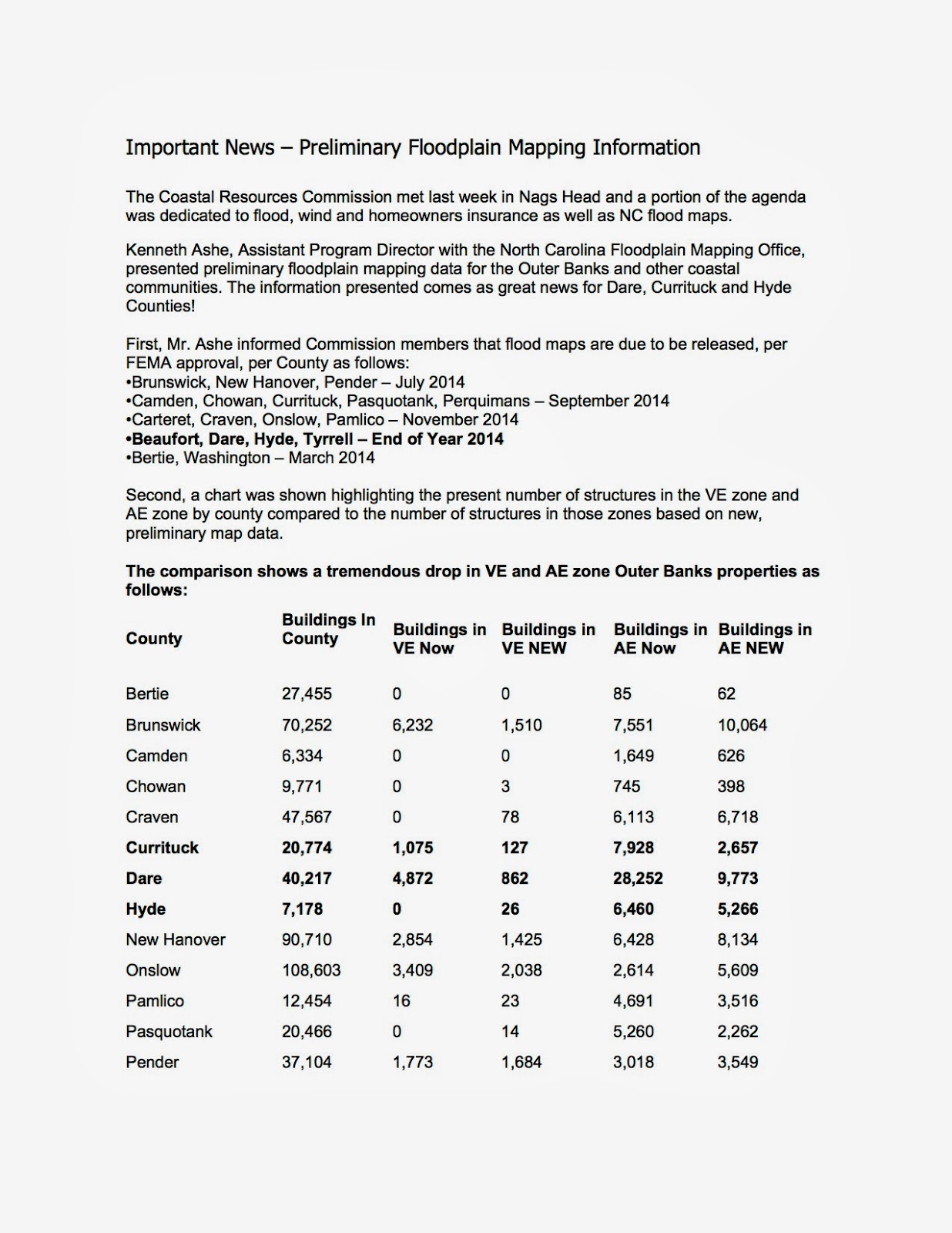
Good News for Flood Zones on Outer Banks
The preliminary data shows an 82% drop in VE zone structures and a 65% drop in AE zone structures! Only structures within those zones are required to have flood insurance when they are covered by a mortgage. If not within the VE or AE zone, property owners can buy flood insurance at greatly reduced, preferred risk rates.
OBAR/OBHBA Government Affairs Liaison Willo Kelly participated in the CRC meeting. She shared the above information as well as an update on homeowners and flood insurance at a meeting last night sponsored by the Dare County League of Women Voters. The Outer Banks Voice will be providing video highlights of that meeting soon at www.outerbanksvoice.
How to attract younger home buyers

If you're selling your home, attracting younger home buyers is going to be important. For the most part, younger home buyers fall into these two groups – Generation X and Generation Y or Millennials.
The largest demographic of home buyers is Generation X, who were born between 1965 and 1979. Millennials, those born between 1980 and 2000, are the second largest. Although they may fall into two demographics, they share common ground not only when it comes to what they look for in a home, but how they look and the most effective ways to sell to them.
Online listing
Younger buyers are more likely to start the search for their new home online. According to the National Association of Realtors®, 90% of buyers use the Internet to search for homes, and 62% of buyers said they walked through a home after viewing the listing online.
Low maintenance
Working around the home is not high on the younger buyers' list. They prefer to keep their weekends free, avoiding chores and maintenance associated with home ownership.
Good location
Some prefer to be closer to the city and mass transportation, while others are considering schools if they have children. Know which your location will appeal to and make sure it’s included in the listing.
Updated kitchen and bathroom
They may not have a lot of money to put into a remodeling project after they purchase; most of their cash just went into the down payment and furniture.
Technology
Cellular service and high speed Internet matter more to younger home buyers, especially since they are less likely than ever to have a landline.
Open floor plan
Younger buyers seem to be attracted to a big kitchen that transitions into a TV room, opting for flow of the home rather than sectioning off a formal dining room, living room, etc.
Home office
Technology offers more people the opportunity to work from home and younger people are most often the ones to take advantage of the opportunity.
Energy efficiency
Whether they're going green or not, a home's energy efficiency is something that most home buyers will ask about.
Staging
Buyers are affected by the home's potential, or how comfortable they are the minute that they walk into a home. Staging, rather than an empty home, is more effective to help younger home buyers imagine themselves in the home.
Attracting younger home buyers will be more important - to sellers and agents alike - as the housing market continues to recover.
Tuesday, March 4, 2014
Using feng shui techniques when staging your home to sell

As you may know, feng shui is a practice that originated in China. It is an ancient art and science developed over 3,000 years ago and is a complex body of knowledge that reveals how to balance the energies of any given space to assure health and good fortune for people inhabiting it.
Literally translated, "feng shui" means "wind water." In Chinese culture, wind and water are associated with good health, thus good feng shui came to mean good fortune, while bad feng shui means bad luck, or misfortune.
For homeowners, everything we associate with staging the home to sell, have their basis in feng shui strategies.
Make the room inviting
If you stand in the entranceway to a room and all you can see are the backs of chairs, it's not very welcoming to guests. Creating spaces in the room where people can sit and talk improves the intimacy of a large room.
Create good traffic flow
Look at the room in terms of creating easy-to-navigate, open pathways. You don't want anything that's going to keep people from feeling that they can move through an area. Use space wisely, and if that means removing a piece of furniture (or even two!) that's OK. You want potential buyers to feel comfortable. Too much in a room can make it feel cramped or claustrophobic.
Use plants and water
Living plants and flowers makes the room vibrant and adds splashes of color. Feng shui also dictates the use of a water feature, because water represents prosperity. The back left corner of a room is the wealth corner. Try placing a small water fountain in that location.
Make a good first impression
Feng shui, like home marketing, is about making a good first impression. You want it to be friendly and positive for all buyers. Choose neutral art that appeals to everyone, such as landscapes and nature scenes. When you're selling, you also want to put away personal family photos and religious and spiritual icons. You want to make it easy for the buyer to imagine their family in the home.
Conclusion
Feng shui alone won't sell your house. You want to make sure to have the right agent, who will help you set the right price and the right marketing plan.
Subscribe to:
Posts (Atom)